According to mainstream media, advertisements, and older research, dopamine is a reward that is addictive.
However, over the past 15 to 20 years, these answers have been proven to be incorrect.
Dopamine is not a reward; it has been proven to be a regulator.
Dopamine is what regulates our decisions and slows our responses. Dopamine allows for the option to choose a response instead of our response being automatic and driven by triggers.
There are two main patterns of dopamine activity in the brain: phasic and tonic. Phasic dopamine involves rapid, short-term changes in dopamine levels that help us respond to immediate events and learn from experiences, such as reacting to brake lights while driving or becoming cautious around a dog that previously bit you. Tonic dopamine refers to the brain’s steadier, background level of dopamine activity, which is associated with ongoing motivation, persistence, and learning over time, such as working toward a college degree or planning and preparing for a future trip (Romero Pinto, S., & Uchida, N. (2025). Tonic dopamine and biases in value learning linked through a biologically inspired reinforcement learning model. Nature Communications, 16, 7529. https://doi.org/10.1038/s41467-025-62280-1).
Recent research indicates that, when at the correct levels, these two forms of dopamine complement each other. But when either one is too high or too low, major mental health issues can arise such as ADHD, anxiety, and depression.
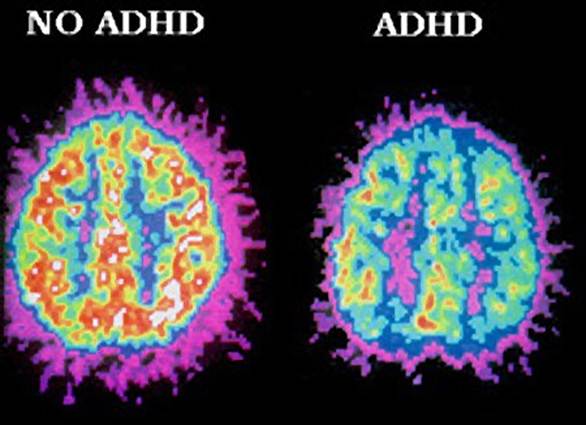
Research shows that without enough dopamine, the executive functioning center is not powered; and therefore, is mostly non-functioning. This can be specifically seen in brain scans of individuals with ADHD where the lack of dopamine causes the executive functioning centers of the brain to be in a state of limited functionality, so much so, that the center of conscious thought and decision-making switches to the daydream center located in the fight or flight system.
The picture shows brain scans of a neurotypical brain on the left and an ADHD brain on the right. The green, orange, red, and yellow coloring shows activity, while blue shows undeveloped brain matter. The purple is the “gel” that protects the brain from smashing into the skull.
In our treatment model at New Heights Counseling Services, we have found that ADHD medications, which raise dopamine, can treat anxiety and depression (Coughlin CG, Cohen SC, Mulqueen JM, Ferracioli-Oda E, Stuckelman ZD, Bloch MH. Meta-Analysis: Reduced Risk of Anxiety with Psychostimulant Treatment in Children with Attention-Deficit/Hyperactivity Disorder. J Child Adolesc Psychopharmacol. 2015 Oct;25(8):611-7. doi: 10.1089/cap.2015.0075. Epub 2015 Sep 24. PMID: 26402485; PMCID: PMC4617411. , Kollins SH, Youcha S, Lasser R, Thase ME. Lisdexamfetamine dimesylate for the treatment of attention deficit hyperactivity disorder in adults with a history of depression or history of substance use disorder. Innov Clin Neurosci. 2011 Feb;8(2):28-32. PMID: 21468295; PMCID: PMC3071091.).
In the next article we will look at how dopamine contributes to and impacts how the brain develops anxiety, depression, and ADHD.